

Instructors Corner
This year, we’re delivering intel-packed briefings designed to strengthen your knowledge base, expand training resources, stabilize tactical units, and ensure operational readiness.
Each briefing provides actionable strategies for:
- Team Structure & Leadership
- Selection & Training Standards & Protocols
- Training Programs & Performance Metrics
- Operational Readiness & Resilience
Own the mission—gain the training intel and tactical advantage you need today!
MINDSET DEVELOPMENT

Mindset Development: From Concept to Application
training. “Warrior Mindset”, “Combat Mindset,” “survival mindset,” “tactical mindset”—these terms are commonly used, often interchangeably, and just as often without explanation. They sound good, but rarely do they explain what mindset actually is or how it is developed and applied. At its core, mindset is a mental framework. According to the dictionary, mindset is a mental attitude or inclination; a fixed state of mind. In practical terms, it is a set of beliefs that shapes how we interpret situations, view ourselves, and decide to act. Mindset influences how we think, feel, and behave—especially under stress. Despite how frequently it is discussed, mindset is often treated as something abstract or mythical, developed through analogies, war stories, or motivational speeches. While those may inspire, they rarely explain the process of mindset development.
Why Mindset Can’t Be “Trained” Like a Skill
You cannot simply train someone to have the perfect mindset. If that were possible, we would produce robots—individuals who follow scripts without independent thought or adaptability. Real-world environments demand critical thinking, judgment, and flexibility. Mindset cannot be issued or installed. It must be developed, and that development is personal. What instructors and leaders can do is create conditions that encourage the right mental habits, reinforce accountability, and build confidence through competence.
Where Mindset Development Begins
Mindset development does not start on the range or in a classroom—it starts with identity. Before learning tactics or techniques, an individual must understand who they are, or who they are striving to become. This foundation may be career-driven, family-centered, faith-based, or values-oriented, but it answers critical questions:
• What do I stand for?
• What responsibilities do I carry?
• What kind of person do I choose to be under pressure?
Without this internal framework, mindset becomes fragile and situational. Identity provides the “why” behind action, and that “why” sustains decision-making when stress and uncertainty are present.
Skill Development Builds Confidence
Once identity is established, mindset is reinforced through deliberate skill development.
Training follows a natural progression:
1. Fundamentals – learning the core principles and mechanics
2. Application – applying those fundamentals in real-world or contextual scenarios
3. Proficiency – performing efficiently, consistently, and under stress
Training is not simply about acquiring techniques. It is about proving capability. The more an individual trains and applies a skill set, the more confidence they develop in their ability to perform. That confidence is not imagined—it is earned.
Confidence as the Foundation of Mindset
Confidence is often misunderstood. It is not bravado or ego. True confidence is evidence-based belief in one’s ability to perform. As confidence grows:
• Fear becomes manageable rather than paralyzing
• Stress becomes information instead of chaos
• Decision-making becomes more deliberate and controlled
This is the point where individuals move away from a fixed mindset—one limited by doubt or fear—and toward a growth mindset, where challenges are seen as problems to solve rather than obstacles to avoid.
Mindset Is a Continuous Process
Proper mindset development is no different than developing any tactical capability. It follows a continuous improvement cycle:
• Understand the principles
• Learn and reinforce the fundamentals
• Apply them in realistic conditions
• Evaluate performance honestly
• Adjust and improve
Mindset is not static. It must be maintained, tested, and refined over time. Without evaluation and self-awareness, mindset degrades just like any other skill.
Everyday Application of Mindset
Mindset is not reserved for combat or crisis situations. It affects daily decision-making, leadership, conflict management, and personal accountability. A poor mindset becomes a liability, while a well-developed mindset acts as a force multiplier across all aspects of life.
Mindset is not a slogan or a motivational catchphrase. It is built on identity, reinforced through competence, and strengthened through experience. You do not train mindset directly—you develop it through disciplined learning, honest self-assessment, and continuous improvement. Understanding this process turns mindset from an abstract concept into a practical tool—one that can be developed, applied, and relied upon when it matters most.
STAY MOTIVATED | TRAIN HARD | HOLD STRONG
Owner/Lead Instructor – Robbie Allmon
SELECTION VS TRAINING
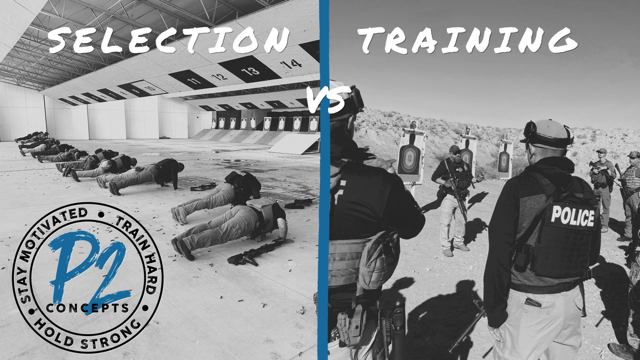
In tactical and law enforcement environments, there is a persistent misconception about the roles of selection and training. While both are essential, they serve distinct purposes and should never be blended into one process. Over the years, I’ve observed instructors mix these two concepts, resulting in courses that were either “fun” or “hard”—but ultimately failed to deliver meaningful learning or accurate assessments. I see this in Basic SWAT courses being instructed. You first have to ask yourself what is the purpose of a Basic SWAT course. Is it to select the right people or train the ones that have been already chosen for a task to perform? So let’s break down the difference between selection and training.
SELECTION
A proper selection process identifies individuals who already possess the required attributes or potential for a role. It is about assessment, not instruction. Selection should:
- Evaluate candidates through physical fitness, practical applications, decision-making scenarios, and psychological assessments.
- Apply baseline standards for each assessment to ensure consistency and fairness.
- Filter out those who are not ready or do not meet the standards.
Selection ensures the right person is placed in the right role. Without this step, you risk assigning individuals who cannot meet or maintain operational standards.
TRAINING
Training begins after selection and focuses on developing skills, knowledge, and behaviors required for success. Its purpose is improvement and growth, not evaluation. Training should:
- Teach fundamentals and advanced techniques in a learning environment
- Close performance gaps and enhance capabilities
- Build confidence and maintain readiness through ongoing development.
Training is where you prepare chosen individuals to perform effectively and uphold standards over time.
Selection and training complement each other, but each has its place. Selection ensures you start with the right people; training ensures those people stay sharp and evolve. Both rely on clear, enforceable standards—selection enforces entry standards, training enforces maintenance standards.
If we fail to distinguish between selection and training, we compromise both processes. Mixing them creates confusion, erodes standards, and diminishes operational effectiveness.
Selection = Choosing the right person.
Training = Preparing that person to perform and maintain the standard.
When we choose the right people through proper selection and then invest in their growth through structured training, we build teams that are capable, confident, and ready for the mission. Anything less is a gamble with safety and success.